
Why Business Buyers Need a Commercial Property Surveyor First
Most business buyers spend weeks reviewing financials and talking to brokers. Then they skip the one step that tells them what they’re actually buying. Hiring a commercial property surveyor before closing shows buyers if the property matches what’s on paper. Skip it and you inherit whatever problems were already there.
This article covers what a commercial property surveyor finds, why it matters for business purchases and what happens when it gets ignored.
What a Commercial Property Surveyor Actually Does
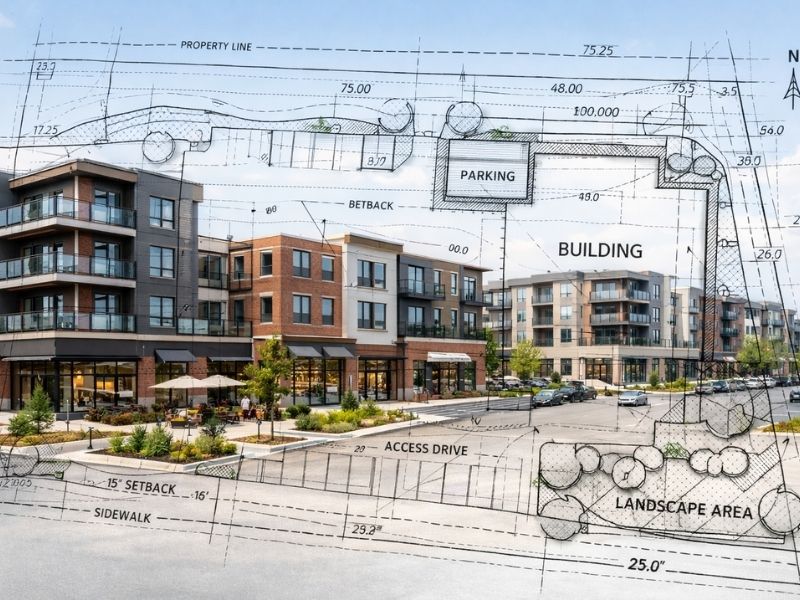
A commercial property surveyor formally measures and documents a property. They visit the site, review recorded documents and produce a drawing. That drawing shows the legal boundary, existing structures, easements, encroachments and flood zone data.
This is not the same as a property inspection. An inspector looks at the building’s condition. A commercial property surveyor looks at the land itself.
A building can pass inspection and still have a boundary problem that blocks financing. Those are two completely different issues.
Why Business Buyers Face Higher Risk Than Homeowners
A homeowner buying a house on a small lot carries relatively low survey risk. The boundaries are usually well-established and the work is straightforward.
Business buyers face a different situation.
Commercial parcels are often larger and more complex. They may have shared access agreements, utility easements or irregular lot shapes. Some were assembled from multiple parcels over time. The legal descriptions don’t always line up cleanly when that happens.
A business buyer purchasing land for a retail center, a warehouse or a medical office is making a decision that affects operations for years. Getting the property wrong at the start is an expensive problem to fix.
What a Commercial Property Surveyor Finds Before You Close
Easements That Limit Your Plans
An easement gives another party the right to use part of your property. Utility easements, drainage easements and access easements all appear on the survey. They get plotted against the property boundary so you can see exactly where they run.
Some easements are minor. Others cut directly through a planned building area or parking lot. Finding that before purchase gives you options. Finding it after the site plan is drawn costs redesign time and money.
Encroachments You Didn’t Know About
An encroachment is anything that crosses a property boundary without legal right. A neighboring building wall, a shared driveway or a fence in the wrong spot.
These are common on older commercial properties. They’re also a serious financing problem. Most lenders won’t fund a deal with an unresolved encroachment. Title companies won’t insure around one without specific negotiations. Finding it before closing puts the problem on the seller. Found after closing, it’s yours.
Boundary Problems in Old Deeds
Older deed descriptions were sometimes written using reference points that no longer exist. A stake, a tree or a corner marker that disappeared decades ago. When a commercial property surveyor goes to locate the boundary, the legal description and the physical conditions on the ground sometimes don’t match.
This happens more often than buyers expect, especially with commercial land that hasn’t changed hands in a long time. A licensed surveyor finds those conflicts before they become your legal problem.
Flood Zone Classification
A commercial survey includes flood zone data for the property. That tells you whether any part of the site falls within a FEMA high-risk flood zone and what insurance and building requirements apply.
For business buyers, this affects construction costs and insurance premiums. It also affects what can legally be built on the site. Getting this information early changes the financial picture for the project.
When Business Buyers Get This Wrong
The most common mistake is treating the commercial property surveyor as a last-minute formality. Buyers order the survey at the end of due diligence, rush the process and then don’t have time to act on what comes back.
A survey that returns problems two days before closing puts you in a bad spot. You’re either closing on a property with known issues or delaying a closing with hard deadlines.
Order the survey the same day you sign the purchase agreement. A standard commercial ALTA survey takes two to four weeks. Complex properties take longer. Ordering early means results come back during due diligence, when you still have time to negotiate or walk away.
How This Affects Financing
Most commercial lenders require an ALTA/NSPS survey before releasing funds. This is a loan condition, not a suggestion.
The ALTA/NSPS standard is set by the American Land Title Association and the National Society of Professional Surveyors. It defines what the survey must show and how it must be certified. A survey that doesn’t meet that standard gets rejected and has to be redone.
Some buyers order a basic boundary survey and find out at closing that it doesn’t satisfy the lender. That mistake adds weeks to the timeline and costs the price of a second survey.
What to Ask Before Hiring a Commercial Property Surveyor
Before signing anything, confirm the following:
- They hold an active license in the state where the property is located
- They have recent experience with commercial ALTA surveys, not just residential work
- The quote covers title research, field work and the final certified drawing
- They can deliver within your due diligence window
- They carry current errors and omissions insurance
Get that in writing. A verbal commitment from an overbooked surveyor is not a schedule.
Frequently Asked Questions
Do business buyers always need a commercial property surveyor?
Any buyer using a lender to finance a commercial purchase will almost certainly need an ALTA/NSPS survey completed by a licensed commercial property surveyor. Cash buyers have more flexibility, but skipping this step carries real risk. Boundary problems and easements don’t disappear because no one documented them.
How is a commercial property surveyor different from a property inspector?
A property inspector looks at the building: structure, mechanical systems and code compliance. A commercial property surveyor looks at the land: boundaries, easements, encroachments and flood zone status. Both are needed. They answer completely different questions.
What is an ALTA/NSPS survey and why do lenders require it?
An ALTA/NSPS survey follows national standards set by the American Land Title Association and the National Society of Professional Surveyors. It covers more than a standard boundary survey and produces a certified drawing that lenders and title companies accept. Most institutional lenders require it before funding a commercial deal.
Can a commercial property surveyor’s findings change the purchase price?
Yes. If the survey finds an encroachment, a conflicting easement or an undisclosed flood zone, those become negotiating points. A seller who knew about a problem has exposure. A buyer who finds it before closing has leverage. Found after closing, there’s nothing left to negotiate.
How long does a commercial property survey take?
A standard ALTA/NSPS survey takes two to four weeks from start to delivery. Properties with large acreage, complicated title histories or multiple easements can take six weeks or more. Order it the day you sign the purchase agreement, not the week before closing.