
What Commercial Buyers Should Check Before Ordering an ALTA Land Survey
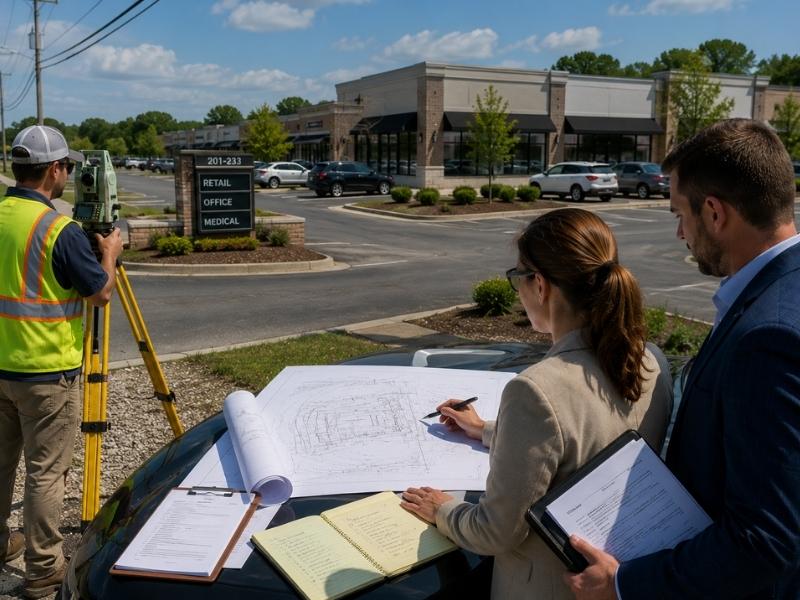
An ALTA Land Survey helps commercial buyers confirm exactly what property is included in a real estate transaction before closing. By identifying property boundaries, easements, access rights, and other title-related matters, an ALTA Land Survey can reveal issues that affect financing, due diligence, and future development plans.
Many commercial transactions involve multiple parcels, older legal descriptions, or shared access areas. If those details are not confirmed before the survey is ordered, the survey, title work, and closing schedule may all need to be revised. Knowing exactly what land is included in the transaction is the first step toward avoiding costly delays.
Why Doesn’t an ALTA Land Survey Use the Street Address?
An address is a mailing convenience. It has no legal meaning, and it routinely fails to describe a commercial property accurately.
Older commercial sites get assembled over decades. An owner buys the corner lot, then the lot behind it, then a strip from a neighbor to widen the driveway. Each purchase carries its own deed and its own legal description. The whole thing operates as one property, sits under one address, and is legally four or five distinct parcels held together by nothing but common ownership.
Buyers regularly sign a contract describing some of them. Then the survey reveals a gap, and the parking lot everyone assumed was included turns out to belong to a parcel the contract never mentioned.
So work from legal descriptions, not from the address and not from a marketing package. Those descriptions are what actually convey land.
How Does an ALTA Land Survey Confirm Every Parcel?
Three sources should be compared, and they should agree.
The purchase contract and its exhibits state what the seller is selling. The title commitment describes what the title company is prepared to insure. The tax parcel records show how the local assessor has carved the land up.
When those three disagree, something is wrong, and finding out which one is wrong is the buyer’s job before the surveyor is engaged.
Watch for these specific problems:
- A parcel appearing in the tax records but missing from the contract
- A legal description that clearly predates a later split or combination
- A description referencing a road or right of way that has since been vacated
- Multiple deeds where one covers land the seller no longer owns
- An access strip or easement parcel that everyone forgot about
That last one causes real damage. A property with no legal access to a public road is nearly worthless, and the access sometimes lives in a separate easement document rather than in the deed itself.
How Does an ALTA Land Survey Identify Gaps and Overlaps?
When several old descriptions get stitched together, the boundaries don’t always meet cleanly.
A gap is a sliver of land that none of the descriptions cover. Nobody’s deed includes it. Legally, somebody owns it, but the paperwork can’t say who. A gap running through the middle of your building footprint is a genuine problem.
An overlap is the opposite. Two descriptions both claim the same strip, which means two parties have paper claims to the same dirt.
These show up on old assemblages all the time, and the survey is usually what reveals them. The surveyor plots each description, sees where the lines fail to meet, and shows the result on the drawing. Resolving one takes time, sometimes a corrective deed, sometimes a quiet title action. That’s not a two-week fix.
Discovering a gap in week two of due diligence gives you options. Discovering it in week seven gives you an extension request.
What Should You Prepare Before Ordering an ALTA Land Survey?
Everything above condenses into a short list. Get these settled first:
- The complete legal description of every parcel in the transaction.
- Confirmation that the contract, the title commitment and the tax records describe the same land.
- Any known gaps, overlaps or access questions, flagged for the surveyor’s attention.
- The engineer’s requirements, if design work follows the closing.
- The lender’s survey requirements, in writing.
Item four trips up more buyers than any other. An ALTA survey serves a real estate transaction. It exists for the title company, the lender and the buyer, and it is not an engineering design survey. The ALTA/NSPS standards address design services through Table A Item 20, which covers professional services negotiated separately between the client and the surveyor. Checking the contour and utility boxes does not get you design-grade topography, invert elevations or detailed utility work.
So bring your engineer into the conversation before ordering. When design starts soon after closing, one properly scoped trip costs far less than two.
Item five saves the most grief. Lenders have survey requirements, they rarely volunteer them early, and a lender who decides in week six that they want something extra has just sent the crew back to the site.
Frequently Asked Questions
What If the Tax Records and the Deed Describe Different Land?
Something needs to be reconciled, and the deed usually governs, since tax parcels exist for assessment rather than for conveying title. A mismatch still signals a problem worth understanding before closing, so your attorney and title company should weigh in before the survey goes out.
What Happens When an ALTA Land Survey Finds a Gap?
The gap has to be resolved, usually through a corrective deed or a legal action to clear title, and neither is quick. This is exactly why the survey belongs early in due diligence. A gap found with six weeks remaining is manageable. One found with six days remaining usually means an extension.
Does an ALTA Land Survey Cover Engineering Design Needs?
Not by default. The standards treat design services as a separately negotiated scope under Table A Item 20, so checking the contour and utility boxes doesn’t produce a design-grade survey. Talk to your engineer before ordering.
Do I Need an ALTA Land Survey for a Single-Parcel Property?
Almost certainly, since parcel count isn’t what drives the requirement. Lenders and title companies want the survey in order to remove the survey exception from the title policy, and that need exists regardless of how simple the property looks.
Who Confirms Which Parcels Are in the Deal?
The buyer, working with their attorney and the title company. The surveyor surveys what they’re given, and they can’t know the contract was missing a parcel unless somebody tells them.